Foods of indigenous or exotic origin that have a place in New Zealand history - colonial or recent.
The emphasis is on authenticity. All our products have their accompanying stories: from the ‘spruce beer’ Captain Cook first made in 1769 from rimu (New Zealand red pine), to award-winning wild food dishes and wild or foraged ingredients. We specialise in finding obscure botanicals to order, including wildling fruits and herbs, garden escapes and fungi.
Price varies according to availability and quantity required.
Products are packaged to order. Some are strongly seasonal. Our range is constantly growing so watch for updates!
For prices and further information please email us
info@heritagefoods.co.nz
Cook's scurvy grass (Maori: nau) Lepidium oleraceum.
One
of the plants Captain Cook famously used to prevent scurvy.
A low spreading native herbaceous perennial with fleshy, tender leaves.
A seashore plant that is now very rare in the wild. Closely related to
garden cress.
Cultivation: Sow thinly in seed-raising mix and transfer to containers
or garden in full sun when 2 cm high. Spray regularly with a fungal spray
such as Saprol to prevent white mould, and feed very generously. Tolerates
wind, salt and severe drought, but must be well protected from snails,
insects and grazing animals. Prune heavily after harvesting the leaves.
Culinary: A very useful herb for enhancing flavour and colour.
Mixes well with all other salad greens. Excellent with beer.
Quick sauté and add to a wilted salad. Quick steam and serve buttered.
For salads, slice thinly as a slaw or use as mixed leaves and dress well.
Goes well with caraway, bacon and sharp dressings. To cook then serve
cold, quick blanch with lots of salt, refresh, then drain well and quickly.
To pureé, blend to a paste with well-cooked parsley and spinach.
Cook’s Scurvy Grass
Native Parsley
Native parsley (Maori: tutaekoau/tutaekawau) Apium prostratum
One
of the plants Captain Cook famously used to prevent scurvy (though he
called it 'sellery' or celery, to which it is closely related.)
A native herbaceous perennial with bright glossy green leaves, similar
to parsley but grows as a sprawling rosette. Naturally occurs along sea
shores but no longer common in the wild.
Cultivation: Plant in seed-raising mix and transfer to large pots
or the garden in full sun when the first true leaves are well formed.
Requires full sun and plenty of fertiliser. Very tolerant of wind, salt
and drought once established. Protect from snails, insects and grazing
animals. Larger trimmings can be struck in water and planted out as cuttings.
Culinary: Intense parsley flavour - economical and labour-saving.
Enhances flavour, colour and texture. Use the whole plant as a culinary
herb and the leaves in salads or as garnish. All parts of the plant are
useable unless they have become yellowish or tough with age.
Particularly useful for infusions and flavouring vegetarian food. Can
be introduced at any stage of the cooking process. For finishing it can
be chopped finely or picked down to individual small leaflets.
Seeds are useful for baking - like extra strong celery seed with poppyseed
texture.
(Sonchus spp.)
A perennial herb with a leafy rosette and dandelion-like flowers, the bases of leaves somewhat wrapped around the stem. Has a bitter milky juice easily removed by bruising and washing.
Culinary: Good leafy vegetable Rich in vitamin C.
Cultivation: Grow in full sun with plenty of nitrogenous fertiliser.
General: Much used by Maori in hangi and stovetop cooking.
Sowthistle
Native Spinach
(Tetragonia tetragonioides)
A much-branching sprawling rich green herb with whitish glands on the leaves and small yellow flowers followed by small red fruits.
Culinary: A good full-flavoured leafy green vegetable. Young fast-grown leaves are best.
Cultivation: easy to grow in full sun, rich well-drained soil.
General: Introduced to western cuisine by James Cook. Today it is more widely appreciated overseas than in New Zealand, for example in California where it is perhaps the most widely cultivated NZ plant.
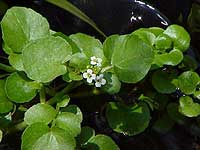
A cress with round leaves and whitish flowers, characteristically found in slow-flowing streams and waterways in New Zealand.
Culinary: Makes a tasty garnish and a robust leafy vegetable. Use in salads or steam. Very popular in Polynesian cuisine.
Cultivation: Easily grown in a large container of water in a sheltered sunny position, or in hydroponics.
(Sarcocornia quinquefolia)
A saltmarsh plant with green, many-jointed green stems, often red at the tips.
Culinary: Tastes salty and asparagus-like; makes an attractive garnish and tasty salad ingredient.
Cultivation: Easy to grow in full sun in a container of sandy soil; very tolerant of wind. As well as normal watering, flood it occasionally with salty water (20g table salt per litre). This imitates the estuary water that occasionally inundates plants in the wild.
(Chenopodium album)
Annual herb up to 2m tall; in places a common weed and garden escape.
Culinary: In our view, this can be the best-tasting of the forage plants. Young plants and vigorous growing shoots make an excellent salad or cooked green vegetable with a delicious, rather nutty flavour.
Cultivation: Full sun, rich well-drained soil.
Fat Hen
(Prumnopitys ferruginea)
Also known as brown pine, this is one of New Zealand’s great rainforest trees. Its berries are an important food of the native wood pigeon (kereru). The small oval resinous berries turn red when ripe, black when dried. We believe this is the southern hemisphere’s best shot at the juniper berry and has a mighty culinary future, eg. with roasting meat or for flavouring grain spirit to make a unique Antipodean gin.
(Dacrycarpus dacryoides)
Yellow, orange or red berries surrounding a small dark seed. They have a sweet astringent flavour.
(Undaria pinnatifida)
As produced in Japan, but of NZ provenance. It reconstitutes easily and is rich in laminarin, mannitol and alginic acid.
Kelp
Available as granules only
(Macrocystis pyrifera)
Dried granules of the world’s largest marine plant; rich in trace
elements, mannitol, laminarin and alginic acid.
Karengo
Available as dried wild fronds only
(Porphyra spp.)
The New Zealand equivalent of the European laverbread and Japanese nori,
the seaweed used for making sushi. Rich in iodine and floridean starch.
(Macropiper excelsum)
Dried leaves of the native kava. Makes a pleasant peppery tea without the narcotic properties of Pacific kava..
We have been foraging the South Island outdoors for many years and know the edible fungi.
Slippery jacks. Dried cleaned caps of Boletus luteus, a mushroom-like fungus which can be easily reconstituted and used to flavour soups and stews.
Cepes or porcini (Boletus edulis). We know a few places where these most sought-after of fungi are to be found in Canterbury! They are strongly seasonal and in very limited supply.
(Pseudowintera axillaris)
leaves impart a a peppery, pungent flavour to fish and meat dishes. Use sparingly.
Horopito Rub
A horopito seasoning as used by Cook ’n’ with Gas, Christchurch, in its entry for the Monteath’s Wild Food Challenge 2002, AD1769: Cook’s coal fish with scurvy grass (see below)
Horopito and Chili Rub
Ideal for applying to fish and meats before barbecuing or roasting.
Horopito Powder
Dried and powdered young horopito shoots. Use sparingly in spice mixtures, rubs and marinades for a peppery flavour.
Horopito Twigs
Place on a barbecue or whittle into skewers or toothpicks for a sharp astringent flavour.
Smoking and curing products
Cracked Black Peppercorns
Birdseye Chillies
Solar
Salt
Large Marlborough salt crystals, produced in New Zealand’s sunniest
province by evaporating the vivid blue waters of Cook Strait.
Smoked Salt and Pepper
As above with coarsely cracked black peppercorns.
Smoked
Salt with Chili
As above with crushed birdseye chillies.
Smoked Salt with Horopito
As above with crushed dried native pepper tree leaves.
Curing Salt
Salt with a trace of saltpetre - for making traditional brines to
pickle meat.
Smoking
Chips
Tea tree chips minimum 5kg
Clean Red Chips of Pohutukawa
Driftwood
(Metrosideros excelsa, the famous native Christmas tree, so called for
its profuse red flowers in December). Highly regarded for all smoking
purposes.
Pohutukawa
Clean red chips made from rata driftwood (Metrosideros robusta), an aromatic rainforest tree from the west coast of the South Island. One of the best woods for smoking.
(Kunzea ericoides), regarded as New Zealand’s best wood for smoking fish, meats and smallgoods.
Pohutukawa chips minimum 5kg
Tea Tree Tea
Tea Tree Tea
Dried leaves of tea tree, an aromatic shrub with a light honey-like aroma.
Rich in antioxidants.
Cook's Spruce Beer Essence
Juice of boiled tea tree and rimu (native ‘spruce’), prepared
exactly as Captain Cook first brewed beer in New Zealand in 1769. With
instructions to make the traditional beer using malt extract and molasses.
Cook’s beer is rich brown with a honey-like aroma, a refreshing
bitter astringent taste and a clean finish.
Spruce Beer
Captain Cook's recipe
As first made in Dusky Sound, 1773.
Flavoured with 'spruce' (rimu) and tea tree
We discovered Cook's description of making an ale
flavoured with 'spruce' (rimu sprigs) and tea tree, while reading the
journal of the Endeavour voyage. Cook described it as "exceeding
Palatable and esteemed by every one on board."
After many experiments to get the ingredients and process right we can
offer this slightly modified recipe made under modern hygienic conditions
by Wigram Brewery. Itis a rich creamy aromatic brew with mild bitterness,
strongly honeyed aromatic overtones and some residual sweetness.
Alcohol 4.9%.
Recommended retail prices (inc. GST)
Bottle $7.95 (bar price)
Bottle $9.00-9.50 (restaurant price)
Wholesale prices (+GST)
500 mL glass bottles with crown cap $43.20 per dozen
50 L keg $130 ea.
Recommended serving : Temperature: 4ºC, in ale glass
Heritage Foods (NZ) Ltd
Ph: (03) 942-0011 Fax: 942-0013
www. heritagefoods.co.nz mail @ heritagefoods.co.nz
Cook's Spruce Beer is
3-5 times richer in antioxidants
than regular beer.*
Captain Cook is famed for never losing a single man to scurvy (vitamin
C deficiency) during his voyages of exploration. In New Zealand, he prevented
this scourge by giving his men beer brewed from rimu (native 'spruce')
and tea tree (manuka), and soup made with local green vegetables - native
celery and a kind of cress known as 'scurvy grass'.
Recent tests conducted by Crop & Food Research for Heritage Foods
Ltd have shown all these to be very rich in antioxidants.
Describing the first-ever brewing of beer in New Zealand, Cook wrote on 8 May 1773, at Dusky Sound, about:
… brewing Beer which we at first made with a decoction of the leaves of the spruce tree mixed with Inspissated juce of Wort and mellasses but finding that the decoction of Spruce alone made the beer to astringent we mixed with it an equal quantity of the Tea plant which partly distroyed the Astringentcy of the other and made the Beer exceeding Palatable and esteemed by every one on board.
*Antioxidant activity Cook's Spruce Beer 585.2 umol TEAC/100ml (normal
beer is about 1/5 - 2/5 this level)
ABTS assay conducted by Dr Carolyn Lister, Crop & Food Research Ltd,
Lincoln
Made from elderflowers steeped in a syrup; tastes very like lychees: warm, floral and tropical. Recommended as a change from fruit juice.
Fresh garden mint steeped in a syrup; makes a refreshing summer drink. Pour over bourbon and ice to make a mint julep.
Cape Gooseberry Jelly
A delicious, fine yellow jelly made from wild cape gooseberries.
Other
Bushman’s Tonic
Essence of horopito, manuka and rimu; rich in terpenes, diterpenoids,
ellagic acid and other antioxidants (Try at own risk)
Gumdigger’s Soap
Dried leaves of Pomaderris kumerahou, or gumdigger’s soap. Rich
in free saponin, used as antiseptic, disinfectant and poultice by gum-diggers.
Super-Calc
Finely crushed clean shells of Pacific oysters from the Marlborough Sounds.
This mineral, called aragonite (calcium carbonate), is an excellent and
readily assimilated source of dietary calcium.